

By Chem. Eng. Moisés R. Hernández
Founder, CEO & Editor-in-Chief — World Academic Podcast | MRH Analysis
PREAMBLE: THE DIVERGENCE DEFINING THE CENTURY
There is a question that should keep European leaders awake every night: how is it possible that Germany, the industrial powerhouse that dominated global markets for a century with the quality of its engineering, is today closing factories while China builds the most formidable energy base in human history?
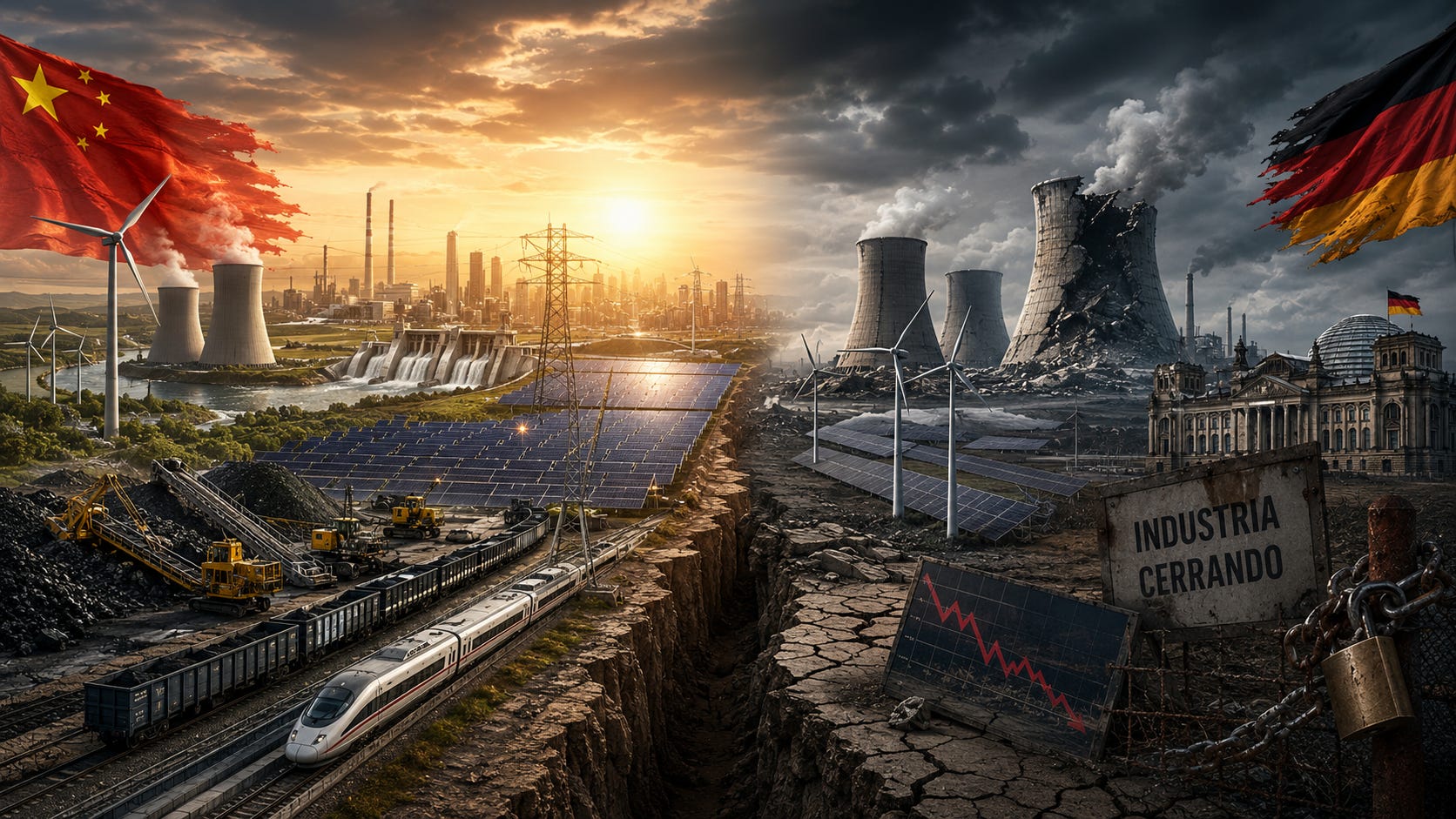
The answer lies in a decision made in Berlin over a decade ago, today revealed for what it truly was: the greatest strategic error in modern energy history. Germany decided energy was an ideological question. China decided it was a matter of national security.
The result of that divergence is plain to see. China operates the world's largest electricity system: 3,349 GW of installed capacity at the end of 2024, generating approximately 10,087 TWh of electricity.¹ It has abandoned no energy source. It combines coal, gas, nuclear, hydro, solar, and wind simultaneously. Germany, meanwhile, shut down its functioning nuclear plants before securing sufficient reliable replacement capacity. The result was dependence on Russian gas first, on imported LNG later, and an energy bill that has destroyed its industry's competitiveness.
This is not a debate about renewables. It is a thermodynamic diagnosis. Because energy is not ideology. It is the metabolism of civilization. And when you mistake one for the other, your civilization shuts down.
If this opened your eyes, someone else needs to read it today.
ACT I: THE DISTINCTION NO ONE EXPLAINS — INSTALLED CAPACITY VS. ACTUAL GENERATION
Before entering the comparison, one must understand a concept most energy debates ignore: the difference between installed capacity and actual generation.
Installed capacity is what a plant could produce under ideal conditions. Actual generation is what it effectively produces. They are not the same. A solar plant has enormous installed capacity, but only generates when the sun shines. A nuclear plant has little installed capacity by comparison, but generates electricity 90% of the time.²
Chinese data illustrate this with devastating clarity. At the end of 2024, China had 887 GW of installed solar capacity —the highest figure in the world— but that capacity only generated 834 TWh of electricity.¹ Meanwhile, nuclear power, with barely 61 GW of capacity —less than 2% of the total— generated 445 TWh, approximately 4.4% of the country's electricity.²
Why? Because a nuclear plant's capacity factor is around 90%. A solar plant's, at best, is around 20-25%. Nuclear produces electricity constantly, 24 hours a day, 365 days a year. Solar produces when the sun decides.
This does not mean solar is useless. It means treating installed capacity as if it were actual generation is an engineering error with catastrophic consequences when it becomes energy policy. And that is exactly what Germany did.
Agree or not? The real debate starts in the comments.
ACT II: THE CHINESE STRATEGY — BUILD EVERYTHING, ABANDON NOTHING
Beijing has not bet its industrial future on a single energy source. It has not chosen between renewables and nuclear. It has not chosen between coal and solar. It has built everything. And it has done so simultaneously, with a coherence that can only be called strategic.
The breakdown of Chinese electricity generation in 2024 is as follows:
Thermal power —coal and gas— remains the backbone of the system. With 1,444 GW of installed capacity, it generated 6,344 TWh, approximately 63% of the country's total electricity.¹ It represents 43% of capacity, but produces nearly two-thirds of the electricity. Because coal and gas work when needed, not when the wind blows or the sun shines.
Hydropower is the second most important source. With 436 GW of capacity, it generated 1,424 TWh, 14% of the total.¹ China not only has the world's largest dams, but is aggressively expanding its pumped-storage capacity to stabilize the grid.
Wind, with 521 GW of capacity, generated 992 TWh. Solar, with 887 GW of capacity, generated 834 TWh.¹ Solar has far more installed capacity than wind, but generates less electricity. That is the difference between a panel that works six hours a day and a wind turbine that can work many more.
And then there is nuclear. Barely 61 GW of capacity —less than 2% of the total— but 445 TWh generated, with a 90% capacity factor.² China approved 11 additional reactors in 2024 alone.
The strategy is transparent: coal for security and flexibility, nuclear for reliable baseload power, hydro and storage for grid balancing, solar and wind for rapid capacity expansion, and ultra-high-voltage transmission to connect production with demand. Beijing is not defending an ideology. It is building an energy system.
Got a question or a data point to add? Message me directly.
ACT III: THE GERMAN SUICIDE — HOW IDEOLOGY DESTROYED AN INDUSTRIAL POWERHOUSE
Germany made the opposite decision. And it made it for reasons that had nothing to do with engineering.
After the Fukushima accident in 2011, Angela Merkel's government decided to accelerate the closure of all the country's nuclear plants. Not because there was a technical risk —Germany is not in a seismic zone comparable to Japan— but because political pressure and anti-nuclear sentiment demanded it.³
The problem was not the decision itself. It was the timeline. Germany shut down perfectly functioning nuclear reactors before building sufficient reliable replacement capacity. Renewables —wind and solar— expanded rapidly, but they are intermittent. When there is no wind and no sun, they do not generate electricity. And Germany did not have enough storage or enough backup to compensate for that intermittency.
The result was growing dependence on natural gas. First, on cheap Russian pipeline gas. When that source was cut off after the 2022 invasion of Ukraine, Germany was forced to import Liquefied Natural Gas (LNG) at much higher prices, competing in the global market with Asia.⁴ Electricity bills skyrocketed. Energy-intensive industries —steel, aluminum, fertilizers, chemicals— began shutting down furnaces. German industrial production has been in decline ever since.⁵
China expanded renewables without dismantling its firm generation. Germany destroyed its firm generation before renewables could sustain the grid on their own. That is the difference between an industrial strategy and a thermodynamic suicide.
Join other readers analyzing geopolitics in real time.
ACT IV: THE CIVILIZATIONAL LAYER — ENERGY AS METABOLISM, NOT IDEOLOGY
Here we arrive at the heart of the problem. It is not technical. It is civilizational.
China has understood something the West has forgotten: energy is not a question of ideology. It is the metabolism of civilization. Every factory, every hospital, every transportation system, every data center depends on a constant flow of abundant, cheap electricity. If that flow is interrupted or becomes too expensive, civilization stops. Literally.
Germany treated energy as a political project. The Energiewende —the energy transition— was sold as a moral imperative, a way to "save the planet" by abandoning nuclear power and fossil fuels. But thermodynamics does not respond to moral imperatives. It responds to physical laws. And the physical law is clear: you cannot power an industrial powerhouse with intermittent sources without firm backup guaranteeing supply when the sun doesn't shine and the wind doesn't blow.
China has understood this. That is why it maintains coal as backup while expanding renewables at industrial scale. That is why it is building nuclear reactors at a pace no other country can match. That is why it invests in ultra-high-voltage transmission to connect the western deserts with the eastern factories.⁶
The result is a thermodynamic divergence defining the 21st century. China has the cheapest electricity in the industrialized world. Germany has one of the most expensive. China is building the energy base that will allow it to dominate industrial production for decades. Germany is closing factories.
CONCLUSION: THE BILL FOR IDEOLOGY
A reader asked what China is doing and how much electricity each technology actually produces. The answer is in the data: China is not betting its industrial future on a single energy source. It is building solar, wind, hydro, nuclear, storage, transmission, and thermal generation simultaneously. It has abandoned nothing.
Germany, meanwhile, treated energy as an ideological question. It shut down its nuclear plants. It became dependent on foreign gas. And now it pays the price: spiking electricity bills, industries closing, competitiveness destroyed.
The lesson is not that renewables are the problem. The lesson is that destroying dependable infrastructure before replacing it creates dependence, higher costs, and industrial vulnerability. Energy is not ideology. It is the metabolism of civilization. And countries that forget it, like Germany, end up shutting down.
World Academic Podcast exists because a select group of readers decided that rigorous, independent analysis is worth defending. Join them: become a paid subscriber to unlock every new publication, support research that interest-driven companies won’t fund, and become part of a community that understands geopolitics for what it really is — not the headline version.
END OF REPORT
Moises R. Hernandez, Chem. Eng. Founder, CEO & Editor-in-Chief — World Academic Podcast | MRH Analysis 200M+ views · 360,000+ followers.
🎁 Visit Here The World Academic Store